

Local Energy Action
The EUSEW Local Energy Action Award recognises implemented sustainable energy actions, driven by a group of citizens, consumers, a municipality or other stakeholders, which contribute to the clean energy transition at the community or local level.
MultiHome Service Hub and Platform
Bulgaria
Plovdiv energy renovation project named as finalist for 2026 European Sustainable Energy Awards
A project in the Bulgarian city of Plovdiv is one of just three finalists shortlisted for a European Sustainable Energy Award for the Local Energy Action category. The MultiHome project promotes integrated home renovation services that make sure that dwellings are warmer and with lower energy bills.
“In Bulgaria, renovation rates have historically stagnated,” says project coordinator Ina Karova, explaining that administrative, technical, and financial obstacles have long hampered essential energy upgrades. While nearly two-thirds of Plovdiv homes are in urgent need of renovation, fewer than 2% of dwellings have done so since 2012 under the country’s National Renovation Programme.
But in Plovdiv, things are changing with MultiHome: since the programme was launched in 2024, it has provided over 250 homeowner consultations in the region and delivered more than 125 supplementary renovation services – ranging from administrative support to technical design and financial engineering.
As a result, 22 multi-family residential buildings have benefited from MultiHome support and will be renovated to high standards, cutting energy consumption and CO2 emissions by over 60%.
“These figures are more than just statistics,” says Karova. “Thanks to this initiative, 1,900 households in Plovdiv will be warmer, more comfortable, and more affordable.”
MultiHome was set up by the Energy Agency of Plovdiv and the Municipality of Plovdiv, with support from the LIFE programme of the European Union, and brings together the municipality, its regional energy agency experts, local renovation businesses, and financial institutions in a market-driven cooperation.
“We have demonstrated that the biggest obstacle to renovations is not technology or funding – it’s market fragmentation,” says Karova. “By bringing all actors together into a transparent, accountable partnership, we turn a hesitant market into a demand‑driven one.”
“It’s a win-win-win approach,” she adds: “Homeowners gain a trusted guide; businesses gain a reliable pipeline of motivated customers; public authorities gain a reliable mechanism to deliver on their decarbonisation and climate targets.”
Karova says the Plovdiv model can unlock the private investment Europe needs to meet its decarbonisation and climate targets. “Every region can start its own self‑reinforcing loop: more renovations – more skilled jobs – more market confidence – even more renovations.”
The initiator Energy Agency of Plovdiv says this cooperation model is already transforming the residential sector in the region and accelerating the clean energy transition of the entire community. By developing a pioneering approach to local energy action, MultiHome boosts the local economy in the Plovdiv region, while building a sustainable energy future for local communities.
MultiHome in Plovdiv is one of three finalists shortlisted for this year’s European Sustainable Energy Awards in the Local Energy Action category. The award recognises sustainable energy actions, which contribute to the clean energy transition at the community or local level.
The other finalists are Nova Energia Osona in Spain and 100 Projects Phasing out Gas in the Austrian capital Vienna. Nova Energia Osona has developed an energy project based on an alliance between local authorities and energy communities in Catalonia. 100 Projects Phasing out Gas is Vienna's good-practice portfolio for phasing out fossil gas in existing buildings and driving the local clean-energy transition towards renewable heating.
The winner will be chosen through an online public vote, which is open from now until 31 May, and will be announced at an awards ceremony in Brussels on 9 June 2026.
EUSEW Awards celebrate Europe’s best clean energy projects and leaders
The European Sustainable Energy Awards (EUSEW Awards) recognise outstanding individuals, projects and initiatives that advance Europe’s transition to clean energy. The nine finalists have been selected by a high-level jury in three categories: SMEs Driving Energy Efficiency, Local Energy Action, and Women in Energy. The finalists will be submitted to an online public vote, which is open now until 31 May, and the winners will be announced during the EUSEW Awards Ceremony on 9 June 2026.
EUSEW 2026
The European Sustainable Energy Week (EUSEW) is the biggest annual event dedicated to renewables and efficient energy use in Europe, and is organised by the European Commission’s Directorate-General for Energy and the European Climate, Infrastructure and Environment Executive Agency (CINEA) The 20th edition of EUSEW will take place in a hybrid format, onsite in Brussels and online, from 9-11 June 2026. European Sustainable Energy Week consists of a three-day Policy Conference, the European Sustainable Energy Awards Ceremony, the Energy Fair and the activities dedicated to the Young Energy Ambassadors. Participants will also have access to independently organised Sustainable Energy Days, taking place in online and physical formats worldwide.
For updates on the agenda and location of the events, please refer to ec.europa.eu/eusew and the new European Sustainable Energy Week (EUSEW) page on LinkedIn. Join the conversation any time on social media via #EUSEW2026.
Other candidates in Local Energy Action
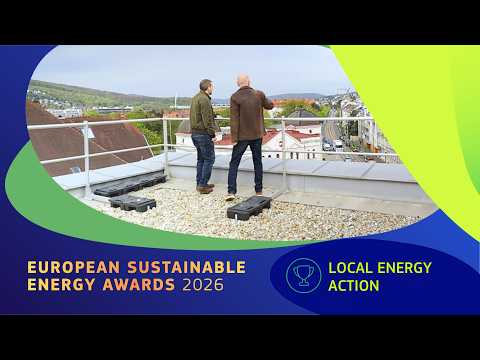
100 Projects Phasing Out Gas
Austria
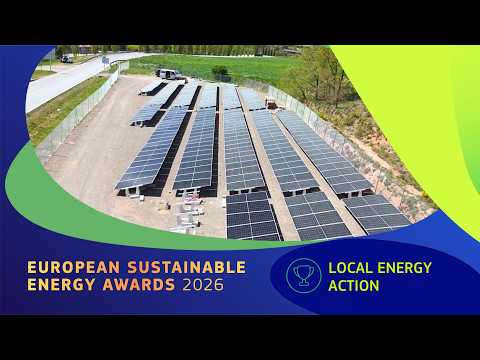
Nova Energia Osona
Spain