


SMEs Driving Energy Efficiency
The Innovative business or financing models for energy efficiency by SMEs Award honours Small and Medium-sized Enterprises (SMEs) that have developed and deployed innovative business or financing models to advance energy efficiency solutions, notably in buildings and industry.
RE-LEAF: Affordable Renovation
Belgium
Belgian lender linking finance with energy advice shortlisted for 2026 European Sustainable Energy Awards
An EU-funded project in the Flemish province of Limburg is pioneering an innovative financing model to tackling energy poverty by linking mortgage planning with renovation advice. The RE-LEAF project brings together the social lender Onesto with local renovation consultants in the Energiehuis Limburg, allowing buyers to assess energy renovations before they take out a mortgage.
Typically, homeowners tend to think of energy renovation only after buying a property, by which time budgets are stretched and comprehensive repairs become difficult. “We saw that many clients were buying affordable homes that turned out to be very expensive to live in,” explains project manager Joris Piette.
What RE-LEAF has done is to shift the moment when renovation is considered: “Instead of treating it as a later step, we integrate energy performance into the decision to buy a home,” says Piette. “By linking mortgage finance with early renovation insights, buyers understand upfront what needs to be done, what it costs, and what energy savings can be achieved.”
The process starts with an early screening using digital tools developed by the project, which provide a reliable estimate of necessary renovation works, likely costs and expected energy savings. This then enables credit analysts to integrate energy performance and renovation feasibility into their loan decisions. Once ownership is secured, clients are matched with providers for full renovation advice and implementation support, ensuring continuity between the initial assessment and the actual renovation.
Renovations typically involve a combination of insulation, efficient heating systems and other upgrades that significantly reduce energy consumption. “In practice, this can reduce energy use by 40 to 60 per cent or more, which translates into much lower energy bills and improved living comfort,” says Piette. Renovation also increases property values by up to 15%.
The LIFE RE-LEAF project builds on the results of an earlier, also EU-funded project, C-REAL, which assessed and advised 148 private homes through a similar approach, with 59 successfully completing the full trajectory from purchase to renovation. The renovations allowed homes to halve their annual energy consumption, directly contributing to reduced CO₂ emissions and lower energy bills.
Kelly is a single mother of three children. She says RE-LEAF was instrumental in allowing her to buy and renovate her house: “It wouldn’t have been possible without them, because when you go to a regular bank, they most likely say no because you're a single mum.”
She says the project then guided her through the renovation. She started with the essentials like the windows, roof, and electricity, “but then I was able to do more than I expected, so now I also have solar panels and a heat boiler, which means a lot in energy efficiency. And it saves a lot of money every month.”
The project is now scaling this business model beyond the Province of Limburg to all Flemish provinces. Through a simplified renovation calculator and expanded partnerships, the approach is now reaching a broader target group of buyers and homeowners. This expansion is expected to further increase renovation rates, unlock additional investment, and contribute to European energy targets by preventing energy poverty before it occurs.
“EU funding was essential in allowing us to test and refine this new approach in real-life conditions,” says Piette. “Through these projects, we were able to work with partners, develop tools, and learn from pilots. This support created the space to innovate beyond day-to-day operations and to build a model that is now ready to scale.”
He adds that financing, renovation and public support too often operate in isolation: “By aligning these roles from the very start, we turn a fragmented process into a coherent pathway for citizens. This is not just a project, but a shift towards a more integrated and inclusive energy transition.”
RE-LEAF is one of three finalists shortlisted for the European Sustainable Energy Awards 2026 in the SMEs Driving Energy Efficiency category. The award recognises Small and Medium-sized Enterprises (SMEs) that have developed and deployed innovative business or financing models to advance energy efficiency solutions, notably in buildings and industry.
The other finalists in this category are the Ener2Crowd project in Italy and Water Horizon in France.Ener2Crowd is an innovative crowdfunding platform raising millions of euros in citizen investments for energy efficiency projects in buildings and industry. Water Horizon offers low carbon cooling solutions, using mobile battery technology to capture waste heat from one place, store it and deliver it as cooling to another.
The winner will be chosen through an online public vote, which is open from now until 31 May, and will be announced at an awards ceremony in Brussels on 9 June 2026.
EUSEW Awards celebrate Europe’s best clean energy projects and leaders
The European Sustainable Energy Awards (EUSEW Awards) recognise outstanding individuals, projects and initiatives that advance Europe’s transition to clean energy. The nine finalists have been selected by a high-level jury in three categories: SMEs Driving Energy Efficiency, Local Energy Action, and Women in Energy. The finalists will be submitted to an online public vote, which is open now until 31 May, and the winners will be announced during the EUSEW Awards Ceremony on 9 June 2026.
EUSEW 2026
The European Sustainable Energy Week (EUSEW) is the biggest annual event dedicated to renewables and efficient energy use in Europe and is organised by the European Commission’s Directorate-General for Energy and the European Climate, Infrastructure and Environment Executive Agency (CINEA). The 20th edition of EUSEW will take place in a hybrid format, onsite in Brussels and online, on 9-11 June 2026. The European Sustainable Energy Week consists of a three-day Policy Conference, the European Sustainable Energy Awards Ceremony, the Energy Fair and the activities dedicated to the Young Energy Ambassadors. Participants will also have access to independently organised Sustainable Energy Days, taking place in online and physical formats worldwide, and this call is open till 24 May.
For updates on the agenda and location of the events, please refer to ec.europa.eu/eusew and the new European Sustainable Energy Week (EUSEW) page on Linkedin. Join the conversation any time on social media via #EUSEW2026.
Other candidates in SMEs Driving Energy Efficiency
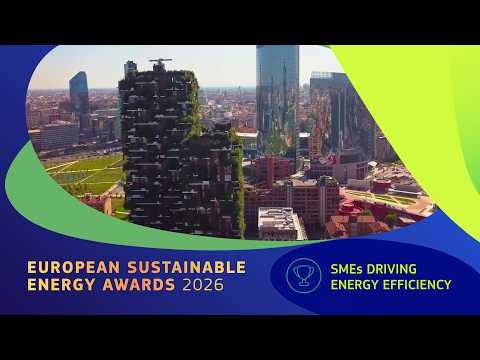
Ener2Crowd: Sustainable Investment Platform
Italy & Spain
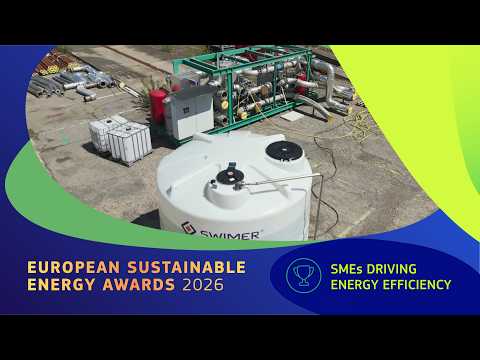
Water Horizon: Cooling-as-a-Service
France