


SMEs Driving Energy Efficiency
The Innovative business or financing models for energy efficiency by SMEs Award honours Small and Medium-sized Enterprises (SMEs) that have developed and deployed innovative business or financing models to advance energy efficiency solutions, notably in buildings and industry.
Ener2Crowd: Sustainable Investment Platform
Italy & Spain
Italian crowdfunding platform for energy projects among finalists of 2026 European Sustainable Energy Awards
An Italian crowdfunding platform is raising millions of euros in investments from citizens for energy efficiency projects in buildings and industry. Through Ener2Crowd, anyone can participate in the clean energy transition by investing in green energy, energy efficiency and environmental sustainability projects with contributions starting from just EUR 300.
Since their inception in 2020, Ener2Crowd has helped to finance over 230 projects in Italy and Spain, boosting access to more affordable and clean energy.
“A major barrier to energy efficiency is the high upfront cost, and the fact that small developers often cannot cover these investments through traditional bank financing alone,” explains business development manager Zeno Gorini. “What we do is essentially unlock financing for Environmental, Social and Governance (ESG) projects through crowdfunding, including energy efficiency projects in residential buildings, commercial spaces, gyms, and more. In this way, capital flows directly into real renovations and efficiency improvements that otherwise might not happen.”
Project developers can approach Ener2Crowd with a clearly defined idea, including a financial plan and a funding request, typically ranging between EUR 100 000 and EUR 1 000 000, with durations of one to four years. Investors – often local stakeholders and community members – can contribute their savings in the form of loans, in exchange for an interest rate.
For example, Ener2Crowd raised EUR 85 000 to finance an energy efficiency upgrade at an organic supermarket in Verona, Italy, including the installation of a 35.20 kWp rooftop photovoltaic system, LED relamping, heat pumps with recovery systems, and a new industrial cooling system. The project offered tiered interest rates* based on proximity to the supermarket ecosystem, ranging from 6% to 10%.1
So far, the platform has raised more than EUR 55 million to fund energy efficiency projects and other green initiatives, engaging over 20 000 citizens. It has also contributed to avoiding more than 1 milion tonnes of CO₂ emissions.
Project manager Julia Semeniuk says the model is highly replicable and ready to scale: “We have millions of buildings that require renovation and a strong need for investment in energy efficiency. At the same time, there is substantial private liquidity held by citizens, amounting to over EUR 8 trillion in Italy and Spain alone2. Mobilising even just 1% of this capital could generate a powerful and immediate impact on the energy transition.”
Significantly, the crowdfunding approach is shifting the way energy efficiency projects are perceived – from being seen purely as a cost, to being recognised as a real investment opportunity.
“While the environmental benefits are already widely acknowledged, what we are showing is that these projects can also generate clear and attractive financial returns,” says Semeniuk. “This reframes energy efficiency as something that is not only necessary, but also economically appealing.”
“As an SME, we have the advantage of being able to move quickly, experiment with new models, and push innovation in a way that larger institutions often cannot,” explains business development manager Gorini.
Ener2Crowd is one of three finalists shortlisted for the European Sustainable Energy Awards 2026 in the SMEs Driving Energy Efficiency category. The award recognises Small and Medium-sized Enterprises (SMEs) that have developed and deployed innovative business or financing models to advance energy efficiency solutions, notably in buildings and industry.
The other finalists in this category are the RE-LEAF: Affordable Renovation project in Belgium and Cooling-as-a-service by Water Horizon in France. RE-LEAF is pioneering an innovative approach to tackling energy poverty by linking mortgage finance with renovation advice. Water Horizon offers low carbon cooling solutions, using mobile battery technology to capture waste heat from one place, store it and deliver it as cooling to another.
The winner will be chosen through an online public vote, which is open from now until 31 May, and will be announced at an awards ceremony in Brussels on 9 June 2026.
EUSEW Awards celebrate Europe’s best clean energy projects and leaders
The European Sustainable Energy Awards (EUSEW Awards) recognise outstanding individuals, projects and initiatives that advance Europe’s transition to clean energy. The nine finalists have been selected by a high-level jury in three categories: SMEs Driving Energy Efficiency, Local Energy Action, and Women in Energy. The finalists will be submitted to an online public vote, which is open now until 31 May, and the winners will be announced during the EUSEW Awards Ceremony on 9 June 2026.
EUSEW 2026
The European Sustainable Energy Week (EUSEW) is the biggest annual event dedicated to renewables and efficient energy use in Europe and is organised by the European Commission’s Directorate-General for Energy and the European Climate, Infrastructure and Environment Executive Agency (CINEA). The 20th edition of EUSEW will take place in a hybrid format, onsite in Brussels and online, on 9-11 June 2026. The European Sustainable Energy Week consists of a three-day Policy Conference, the European Sustainable Energy Awards Ceremony, the Energy Fair and the activities dedicated to the Young Energy Ambassadors. Participants will also have access to independently organised Sustainable Energy Days, taking place in online and physical formats worldwide, and this call is open till 24 May.
For updates on the agenda and location of the events, please refer to ec.europa.eu/eusew and the new European Sustainable Energy Week (EUSEW) page on Linkedin. Join the conversation any time on social media via #EUSEW2026.
Other candidates in SMEs Driving Energy Efficiency
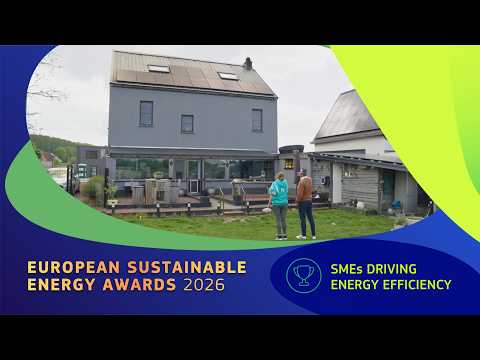
RE-LEAF: Affordable Renovation
Belgium
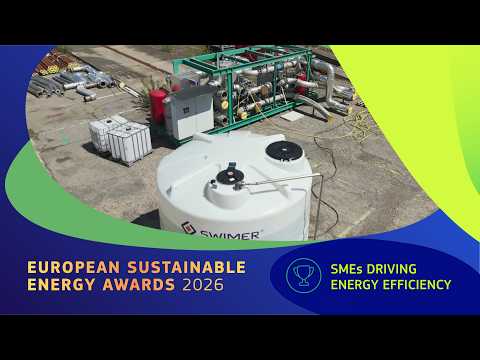
Water Horizon: Cooling-as-a-Service
France