

Women in Energy
The EUSEW Women in Energy Award recognises women who lead outstanding activities that, if replicated, help to advance the clean energy transition in Europe. Particular attention is placed on efforts to drive the gender mainstreaming agenda and support equality and equal opportunities in the energy sector. Shortlisted candidates also inspire and motivate others to implement similar solutions across the EU, resulting in wider social, economic and environmental benefits.
Suzanne Renard
France
French community energy pioneer driving women’s leadership among the finalists of 2026 European Sustainable Energy Awards
For Suzanne Renard, clean energy is not just a technical commodity, it’s a democratic challenge and a tool for social justice. As head of investment at Énergie Partagée – a national movement that brings together, supports, and finances citizen-led renewable energy projects in France – she leads a team developing innovative financial solutions to scale energy communities across Europe. And as a role model for climate justice, she demonstrates how women’s leadership can dismantle barriers in the energy sector.
Indeed, Suzanne insists that she is not just a finance officer; she is a ‘social engineer’ who understands that the technical energy transition will fail without a democratic financial transition. “My focus is to prove that citizen energy is not a niche, but a scalable solution,” she says. “We try to bridge the gap between ‘clean’ and ‘fair’. By accompanying certified citizen projects, we ensure that energy isn't just carbon-free, but owned by the people.”
Behind that narrative lies an impressive set of results. In the last few years, Énergie Partagée boasts an undeniable impact: 448 certified citizen projects. These projects have been fuelled by a total of 32 464 citizen shareholders and 827 local authorities, who have invested over EUR 67 million.
How does it work? Énergie Partagée pools citizen savings into shares to invest directly in community solar, wind, biogas, and hydro projects. Suzanne says this approach ensures that sustainable finance can bring environmental and social benefits to communities: “Our work contributes to financing local services, ensuring that for every EUR 1 invested in a citizen project, EUR 2.5 stay in the local economy. We are not just building solar panels, we are building local resilience and public acceptance for renewables.”
For example, in the Sarthe Department of the Loire, Énergie Partagée has invested more than EUR 135 000 in a project refurbishing two disused hydroelectric sites on the Huisne River – a former mill and a paper mill. The facilities will generate 1 697 MWh per year in renewable energy, while restoring the river’s biodiversity by installing channels that allow fish and other marine life to pass freely down the river, which had not been possible for around 50 years.
Suzanne is also working to replicate this approach across Europe. Through her position as a Board Member of the European federation of energy communities, REScoop.eu, as well as through the ACCE project (Access to Capital for Community Energy), she is actively supporting other groups across Europe through knowledge sharing and technical assistance.
“I want to shift the narrative,” says Suzanne: “Energy isn't just about technology, it’s about social justice and finance. By occupying a space – investment management – that is traditionally male-dominated, I hope to show young women that they can be the architects of the system.”
Recognising that energy communities must reflect the diversity of the territories they serve, she actively promotes the participation of women and youth. And by integrating gender inclusive perspectives into financial and organisational structures, she leads by example, ensuring that the energy transition is not only green, but socially equitable.
“We are ensuring that our recruitment and governance structures reflect the diversity of the world we are trying to change,” she says, adding a strong message for young women: “Your skills combined with your vision for equity are the most powerful tools we have to fight climate change.”
Suzanne Renard is one of three finalists shortlisted for the European Sustainable Energy Awards 2026 in the Women in Energy category. The award recognises women who lead outstanding activities that, if replicated, help to advance the clean energy transition in Europe. Particular attention is placed on efforts to drive the gender mainstreaming agenda and support equality and equal opportunities in the energy sector.
The other finalists in this category are Donna Gartland from Ireland, and Nadia Horstmann from Germany. Donna is driving Ireland’s transition to low-carbon heat while mainstreaming gender equality in the energy sector. Nadia plays a key role at the German Energy Regulator and champions gender equality at national and international level.
The winner will be chosen through an online public vote, which is open from now until 31 May, and will be announced at an awards ceremony in Brussels on 9 June 2026.
EUSEW Awards celebrate Europe’s best clean energy projects and leaders
The European Sustainable Energy Awards (EUSEW Awards) recognise outstanding individuals, projects and initiatives that advance Europe’s transition to clean energy. The nine finalists have been selected by a high-level jury in three categories: SMEs Driving Energy Efficiency, Local Energy Action, and Women in Energy. The finalists will be submitted to an online public vote, which is open now until 31 May, and the winners will be announced during the EUSEW Awards Ceremony on 9 June 2026.
EUSEW 2026
The European Sustainable Energy Week (EUSEW) is the biggest annual event dedicated to renewables and efficient energy use in Europe, and is organised by the European Commission’s Directorate-General for Energy and the European Climate, Infrastructure and Environment Executive Agency (CINEA). The 20th edition of EUSEW will take place in a hybrid format, onsite in Brussels and online, from 9-11 June 2026. European Sustainable Energy Week consists of a three-day Policy Conference, the European Sustainable Energy Awards Ceremony, the Energy Fair and the activities dedicated to the Young Energy Ambassadors. Participants will also have access to independently organised Sustainable Energy Days, taking place in online and physical formats worldwide, and this call is open till 24 May.
For updates on the agenda and location of the events, please refer to ec.europa.eu/eusew and the new European Sustainable Energy Week (EUSEW) page on LinkedIn. Join the conversation any time on social media via #EUSEW2026.
Other candidates in Women in Energy
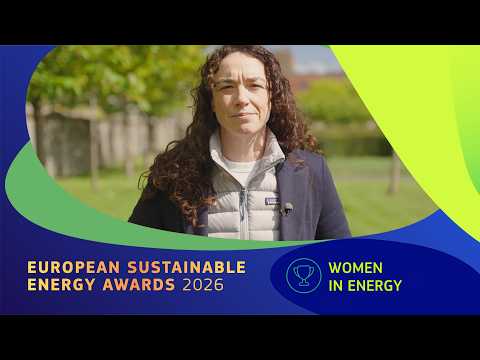
Donna Gartland
Ireland
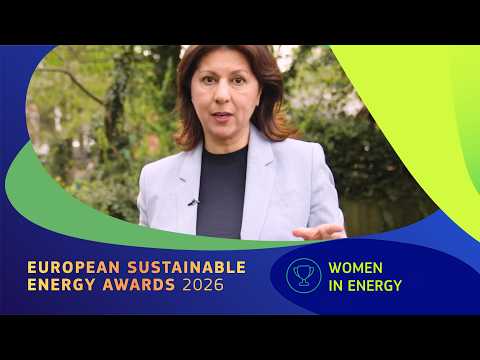
Dr. Nadia Horstmann
Germany